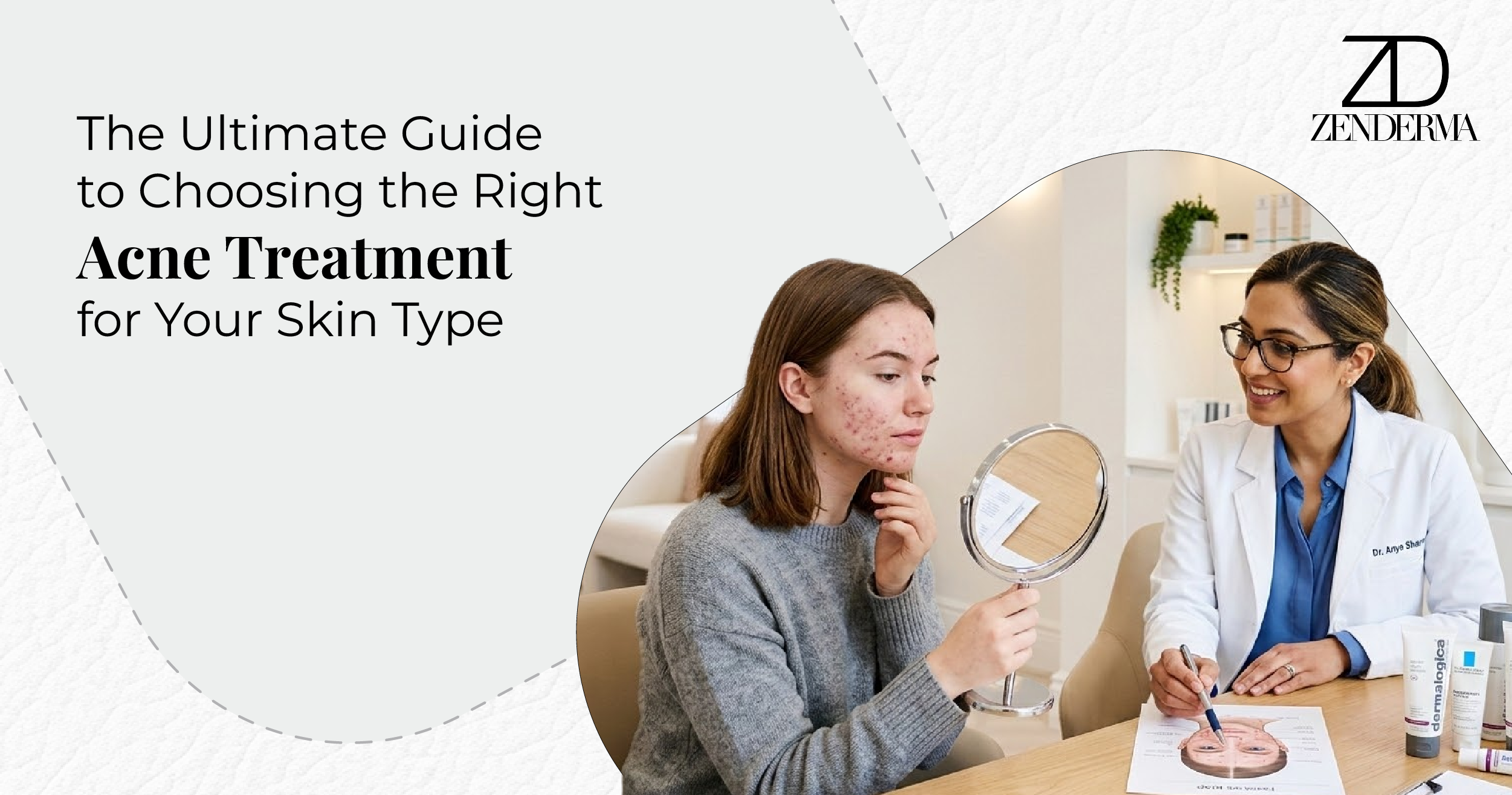
Selecting the ideal acne treatment for skin type is essential for achieving clear results without causing irritation. This guide will help you understand the differences between oily, dry, sensitive, and combination skin types, which all need different active ingredients and treatments. Find out how Zenderma can help you get healthy skin for life by giving you personalised dermatological care based on your skin type.
Why Skin Type Is Important For Treating Acne
Acne is a common skin problem in the UK, but it is also one of the hardest to treat. Why? This is because a “one-size-fits-all” treatment plan never takes into account how your skin works. First, you need to know how your skin makes sebum, keeps moisture, and reacts to the environment in order to find the best acne treatment for skin type.
Using a drying and irritating product on sensitive skin may cause chemical burns, and using a rich and creamy product on oily skin may clog pores. At Zenderma, werecognisee that accuracy in diagnosis translates to perfection in results. By matching medical-grade ingredients to your specific skin type, you can eliminate acne while maintaining a healthy, strong skin barrier.
Identifying Your Skin Type for Acne Success
Before diving into treatments, let’s categorise the four primary skin types and how they typically manifest acne:
| Skin Type | Common Characteristics | Typical Acne Presentation |
| Oily | Shiny appearance, enlarged pores. | Cystic acne, blackheads, and whiteheads. |
| Dry | Dry, flaky skin that feels tight and dull. | A weak skin barrier may result in complex, red papules developing on the skin. |
| Sensitive | The skin is easily irritated by stinging, itching, or redness. | Acne that is inflammatory and persistent can also lead to red scars. |
| Combination | The cheeks are dry, but the T-zone (forehead and nose) is oily. | The majority of pimples were located on the chin and forehead area. |
Acne Treatment For Skin Type: A Tailored Plan
1. Oily Skin: Control Sebum Without Drying It Out Too Much
- For oily skin, the goal is to stop the production of sebum and break up the “glue” that holds dead skin cells together.
Salicylic Acid (BHA) is the best active ingredient in this group because it can dissolve in oil and get deep into the follicle. - Clinical Strategy: Use light, water-based gels or foams instead of rich creams.
- Zenderma Secret: To effectively treat oily skin, you can opt for a Carbon Laser Peel or a Salicylic Acid Peel to thoroughly cleanse your pores and shrink your sebaceous glands.
2. Dry Skin: Hydration-First Acne Care
- People with dry skin often forget that they can still suffer from acne. Dry skin can become cracked, allowing bacteria to penetrate.
- Top Active Ingredients: Lactic Acid or Azelaic Acid. These are less irritating and will help hydrate the skin as it exfoliates.
- Clinical Strategy: Using non-foaming, lipid-free cleansers and “sandwiching” active products between layers of moisturiser.
- Zenderma Secret: Our HydraFacial treatments are ideal for dry, acne-ridden skin because they remove impurities while simultaneously delivering moisturising serums to the skin.
3. Sensitive Skin: Soothing the Inflammation
- Sensitive skin requires a “low and slow” approach to avoid triggering contact dermatitis.
- Top Active Ingredients: Niacinamide and low-concentration Adapalene. Niacinamide is great at addressing the redness that comes with inflammatory acne.
- Clinical Strategy: Fragrance-free, hypoallergenic products. A patch test is always necessary before introducing any new actives.
- Zenderma Secret: LED Light Therapy is a non-invasive, chemical-based treatment that destroys acne-causing bacteria and inflammation without any physical discomfort.
4. Combination Skin: Zonal Treatment
- Some combination skin may require “multi-mapping, ” where diverse parts of the face receive different care. Two main actives with the highest efficacy are Salicylic Acid in the T-zone and Hyaluronic Acid in the cheek area.
- Clinical Mood: Use a balancing toner only on the oily parts and a richer cream only on the parts where the skin feels dry.
- Zenderma Secret: We tailor our Medifacials while you are receiving them.
Zenderma: Custom Dermatology Solutions for All Skin Types
Here at Zenderma, we don’t only address the symptoms; we also focus on the root cause. As a premier dermatology and aesthetic clinic, we strive to deliver scientifically validated acne treatments for each skin type that offer results far superior to other options in the market.
Dr Neeti Kumari, who has over 13 years of experience as a dermatologist, leads the following advanced treatments:
- BioRePeel is a two-phase TCA peel that effectively eliminates acne and scars without any downtime.
Medical Perspectives on Acne Management
Clinical guidelines from the Primary Care Dermatology Society (PCDS) emphasise that moderate to severe acne often requires a combination of topical and systemic treatments.
Topical retinoids are very important for “comedonal” acne (blackheads) because they help control how quickly skin cells turn over.
Benzoyl Peroxide is a very strong antibacterial agent. People have said, though, that it can bleach fabrics. Also, if you don’t use the right moisturiser with it, it can make your skin very dry.
Hormonal Influence: For adult women, acne is often driven by androgens. In such cases, topical treatments might be supplemented with specific oral contraceptives to balance the skin’s environment.
5 Common Myths About Acne Treatment
Myth: Exposure to the sun helps to get rid of acne.
Fact: It might help dry out the skin, but it might also make it thicker and cause post-inflammatory hyperpigmentation (PIH), which could lead to more clogged pores in the future.
Myth: You have to scrub your face to get rid of acne.
Fact: If you don’t put lotion on your skin, it may get “rebound oiliness” as it tries to make up for the lack of moisture.
Myth: Acne happens when you don’t take care of your skin.
Fact: Acne is a complicated problem that has to do with hormones, genes, and bacteria. It can actually make things worse if you wash your face too much.
Myth: The more money you spend on something, the better it will work.
Fact: It’s not the price that matters; it’s the ingredients and how they are put together.
Getting Your Skin to Look Its Best
It takes time and knowledge to find the right acne treatment for skin type. By deciphering the language of your skin, whether it is crying out for more hydration or a deeper clean, you can make informed decisions that will lead to a lifetime of clarity.
At Zenderma, the best skin care clinic in chennai, we are committed to helping you on this journey with “Precision in Dermatology and Perfection in Results.”
FAQs
1. How do I know which acne treatment for skin type is right for me if I have a “sensitive” oily face?
You should opt for “short-contact therapy,” where you leave active ingredients like Benzoyl Peroxide on for a few minutes before washing off to build tolerance.
2. Can I use Retinol if I have dry, acne-prone skin?
Yes, but you must use the “sandwich method”: apply a layer of moisturiser, then your retinol, then a layer of moisturiser to prevent flaking.
3. Is it safe to get a chemical peel during an active breakout?
Some peels, such as Salicylic Acid or BioRePeel, are specifically formulated to treat active acne by killing bacteria and reducing inflammation.
4. How long does it take to see results from a new treatment?
The skin cycle takes about 28 days. You typically need 4 to 8 weeks of consistent use to see a significant reduction in acne.
5. Does what I eat have an effect on my acne?
Some people may get flare-ups because of their diet, which can include a lot of glycaemic foods and dairy products. This is because these foods make the body make insulin-like growth factor (IGF-1).
6. How does a Zenderma Medifacial differ from a spa facial?
Spa facials are meant to help you relax, but Zenderma Medifacials use medical-grade ingredients and tools to treat problems like acne and scars.
7. Can I combine different acne treatments in the same routine?
Yes, but when using them together, you need to be very careful not to overdo it causing irritation; it is advisable to only introduce a single active ingredient at a time so as not to have a reaction.
8. Should I stop using my acne treatment once my skin clears?
No, not right away; maintenance therapy is often necessary to prevent the return of the comedones, especially if the acne is hormonally based.
9. Is spot treatment better than applying the product to the whole face?
Spot treatment can be a good idea for the occasional pimple; however, when you have persistent acne, the product should be applied in thin and even layers to the areas that are prone to acne.
10. Can stress make my acne worse?
Yes. The body produces more cortisol when you are under stress, and this hormone has a tendency to cause the skin to make more sebum which can then result in breakouts.

Dr. Vignesh Karthik, MD (DVL)
Meet Dr. Vignesh Karthik, MD (DVL) – the expert mind behind Zenderma. With 15+ years of dermatology experience, he leads with precision and compassion. From advanced skin therapies to aesthetic care, your skin is in trusted hands. At Zenderma, we blend science with a personalized approach for every skin type. It’s not just treatment – it’s expert-driven transformation.