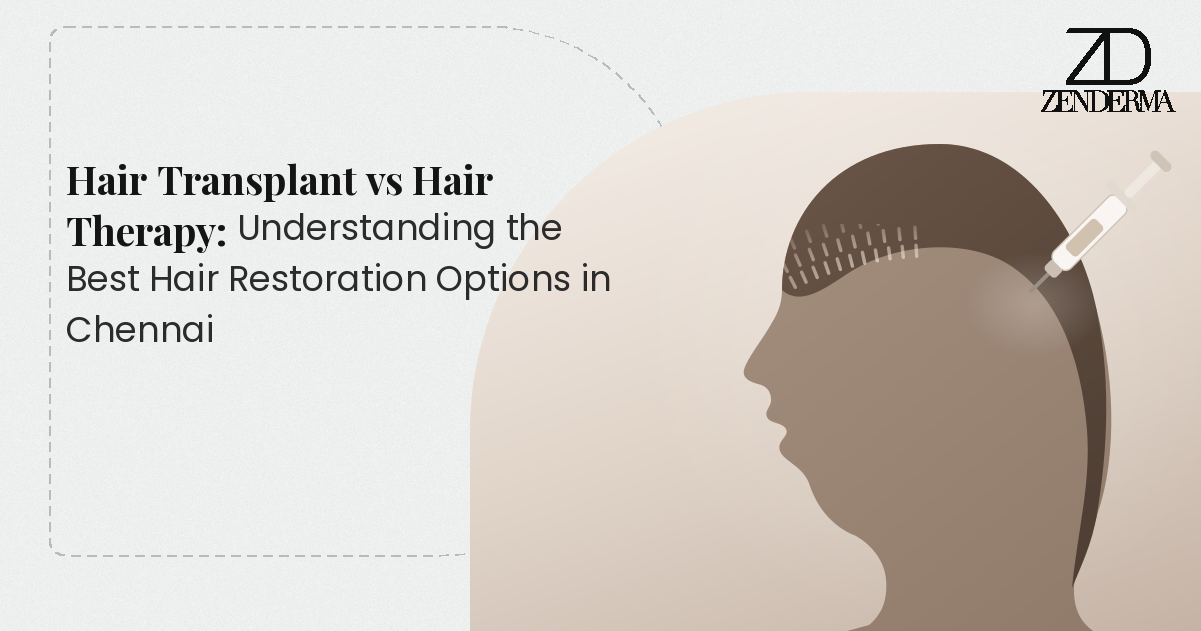
A person can choose between a hair transplant clinic in Chennai and nonsurgical hair therapy based on their reasons for thinning hair, level of density loss, and presence of inactive follicles. An individual assessment could guide a person towards making the right choice. Depending on the cause, the best hair treatment in Chennai could be either of these options. At Zenderma, we carry out personalised dermatologist-led assessments to help determine the most appropriate treatment approach.
Key Takeaways
- Hair therapy and hair transplantation are two very different approaches and are not substitutable for one another.
- The use of hair treatment will depend on the condition that causes hair shedding.
- A transplant physically moves healthy follicles into areas affected by permanent pattern hair loss.
- A dermatologist should identify the cause before choosing a procedure or treatment.
- The right hair treatment in Chennai depends on diagnosis, follicle health, donor density and treatment goals.
Intro: Hair Loss Is Not Always a Transplant Problem
Here is the part that often gets missed: hair fall is a symptom, not a diagnosis. One person may notice excessive shedding after illness or nutritional problems, while another may gradually develop a widening parting or receding hairline because of androgenetic alopecia. Those two situations can look similar in the mirror but require very different clinical thinking.
The question, therefore, should not simply be, “Which treatment is best?” A better question is, “Is the follicle still capable of producing hair, and what is causing the loss?”
That distinction changes everything.
Hair Therapy vs Hair Transplant: What Is Actually Different?
The simplest way to understand the difference is to think about support versus replacement. Hair therapy generally aims to improve the environment or biological activity around existing follicles. A hair transplant, by contrast, involves surgically moving hair follicles from a donor area to an area where greater density is required.
General differences between non-surgical hair treatment and hair transplantation
| Feature | Hair treatment | Hair transplant |
| Main purpose | Manage hair loss or support existing follicles. | Restore density to suitable thinning or bald areas. |
| Surgery | Usually non-surgical. | Surgical procedure. |
| Existing follicles | Relies on viable follicles. | Introduces transplanted follicles. |
| Donor hair required | Not necessarily. | Yes. |
| Maintenance | May require ongoing treatment. | Transplanted follicles can provide long-term growth, but native hair may continue thinning. |
| Best suited to | Depends on diagnosis and follicle activity. | Selected patients with suitable donor hair and appropriate recipient areas. |
A transplant does not stop every form of hair loss. The AAD notes that medical treatment may still be recommended after transplantation because native hair can continue to thin. That is why transplantation and hair treatment should not automatically be viewed as competing choices.
When Can Hair Therapy Make More Sense?
Sometimes the scalp needs treatment before it needs surgery. If hair is thinning but follicles are still producing finer strands, a dermatologist may first consider approaches designed to preserve or support those follicles. If you are searching for a hair loss clinic near me, an accurate diagnosis is the first step towards choosing the most appropriate treatment. Depending on the diagnosis, this may include medicines, scalp-directed procedures or regenerative treatments such as PRP.
At Zenderma, we offer Root Revival Therapy, Scalp Reset Therapy and Exorenew Scalp Reset, with personalised protocols designed around hair fall, thinning and overall scalp health.
Hair therapy may be considered when:
- Hair is thinning rather than completely absent.
- Follicles are still active.
- Hair loss warrants medical evaluation.
- Scalp health is contributing to the problem.
- The aim is to preserve existing density.
- A dermatologist believes non-surgical management is appropriate.
The important word is “considered”. No therapy should be presented as universally suitable for every type of hair loss.
When Does a Hair Transplant Become Worth Discussing?
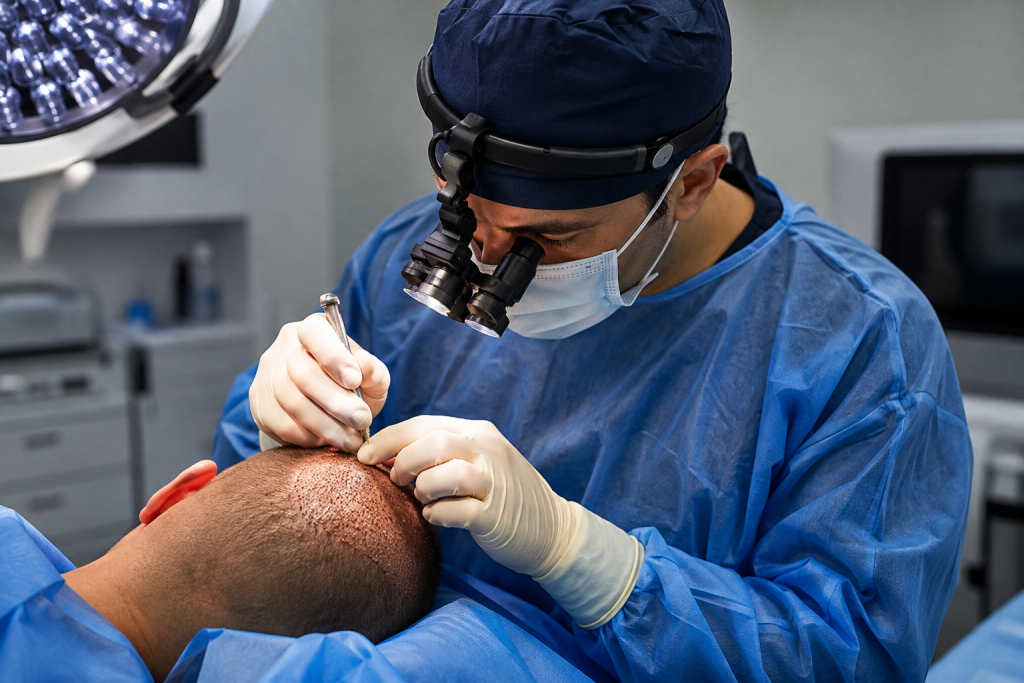
Now imagine a different situation. The hairline has receded significantly, the crown has become visibly sparse, and the affected areas have remained thin for a long time. If healthy donor follicles are available, transplantation may become a more logical conversation.
A hair transplant moves healthy follicles from one part of the scalp into areas affected by thinning or baldness. Modern techniques transplant individual follicular units rather than the large “hair plugs” associated with older procedures.
A transplant may be considered when:
- The pattern of hair loss is established.
- The recipient area can support transplanted follicles.
- Adequate donor hair is available.
- The underlying diagnosis has been assessed.
- Expectations are realistic.
So, searching for the best hair doctor should not be about finding someone who recommends surgery immediately. It should be about finding someone who can tell you when surgery is appropriate and when it is not.
The Decision Starts With the Scalp, Not the Procedure
This is where a proper consultation becomes more valuable than an attractive treatment menu.
A dermatologist may examine the scalp pattern, hair density, shedding history, family history and the condition of the follicles. Depending on the presentation, additional investigations may be needed to look for underlying causes.
A Practical Decision Pathway
Step 1 — Identify the pattern
Is the loss diffuse, patterned, patchy, sudden or concentrated around the hairline?
Step 2 — Look for the cause
Medical conditions, nutritional problems, hormonal factors, inflammatory scalp disorders and hereditary hair loss can all require different approaches.
Step 3 — Assess follicle activity
If follicles remain viable, treatment may focus on supporting and preserving them.
Step 4 — Evaluate donor density
If transplantation is being considered, donor hair quantity and quality become important.
Step 5 — Discuss realistic outcomes
A good plan should explain what improvement is achievable rather than promising a particular density.
This diagnosis-first approach is consistent with dermatology guidance: the AAD stresses that identifying the underlying cause is the starting point for effective hair-loss management.
What Happens During a Hair-Restoration Consultation?
The consultation is often the moment when a confusing hair problem starts to make sense. Rather than jumping straight into a procedure, the dermatologist can discuss how long the problem has been present, whether shedding is increasing and whether the pattern suggests hereditary hair loss or another condition. If you are searching for a hair loss clinic near me, a detailed consultation can help identify the underlying cause before any treatment is recommended.
Expect the conversation to cover:
- Duration and progression of hair loss
- Family history
- Previous treatments
- Scalp symptoms such as itching or scaling
- Hairline and crown density
- Donor-area quality
- Medical history and relevant medicines
- Lifestyle and nutritional factors
- Treatment expectations
The AAD notes that dermatologists may use scalp examination and, when necessary, blood tests or other investigations to determine the cause of hair loss.
That is a much more useful starting point than choosing a procedure because it is trending on social media.
Can Hair Treatment and Transplantation Work Together?
Yes — and this is one of the most important points to understand.
A transplant can place healthy follicles into areas where density has been lost, but it does not necessarily prevent ongoing thinning of the patient’s original hair. Medical or supportive treatment may therefore be recommended alongside or after transplantation.
Think of it as a two-part strategy:
- Transplantation → addresses suitable areas of established hair loss.
- Hair treatment → may help manage or support remaining hair, depending on diagnosis.
This combined approach can be particularly relevant when the hairline has receded but surrounding native hair is also becoming progressively finer.
Three Common Hair-Restoration Mistakes
The internet makes hair restoration look surprisingly simple.
In reality, three mistakes repeatedly lead people towards unsuitable treatment.
1. Choosing a transplant too early
If active hair loss has not been assessed, transplantation may not address the whole problem.
2. Expecting hair therapy to recreate lost follicles
Non-surgical treatments cannot simply manufacture new donor follicles where follicles are permanently absent.
3. Selecting treatment based on price alone
A low-cost procedure is not automatically a good-value procedure if the diagnosis, technique or follow-up is inadequate.
A better strategy is simple: diagnosis first, treatment second, expectations third.
A Realistic Patient Perspective
Hair restoration is rarely a single dramatic moment. The more realistic experience is usually gradual: first understanding the reason for hair loss, then deciding whether to stabilise existing hair, improve scalp health, consider regenerative treatment or discuss transplantation.
Published clinical guidance also reinforces this gradual perspective. After a hair transplant, the AAD notes that visible results commonly develop over months, with many patients seeing results around six to nine months and some requiring up to a year.
For that reason, a responsible consultation should focus on progress, not instant transformation.
Note: No verifiable first-person Zenderma hair-transplant testimonial was available in the sources reviewed for this article, so no invented patient experience has been presented as a genuine testimonial.
Why Choose Zenderma for Hair Restoration in Chennai?
When the concern is hair loss, the clinic matters — but the diagnostic process matters even more.
At Zenderma, we take a dermatologist-led approach to hair restoration. We offer Root Revival Therapy, Scalp Reset Therapy and Exorenew Scalp Reset for different hair and scalp concerns. Our treatment approach also includes scalp diagnostics, personalised treatment protocols and ongoing monitoring to support long-term hair health.
We are located in Teynampet, Chennai, and our dermatology team is led by Dr Vignesh Karthick, MD DVL, who has more than 14 years of clinical experience. If you are looking for the best hair doctor to assess your hair loss and recommend a personalised treatment plan, we can help identify the most suitable approach based on your scalp condition and treatment goals.
If you are comparing a hair transplant clinic in Chennai, we recommend starting with a dermatologist consultation rather than immediately opting for surgery. We can help determine whether hair treatment, medical management, hair transplantation or a combination approach is the right choice for you.
Conclusion: What Is the Best Hair Restoration Option?
There is no single best hair treatment in Chennai for every person because hair loss does not have one universal cause.
Hair treatment may be appropriate when follicles remain active, and the goal is to manage shedding, support existing hair or improve scalp health. A transplant may be more suitable for selected patients with established pattern hair loss, adequate donor hair and realistic expectations. The best route is therefore the one based on diagnosis rather than marketing.
| If you are unsure whether hair treatment or hair transplantation is right for you, book a dermatologist-led consultation with us at Zenderma. We will assess your hair loss and recommend a personalised treatment plan based on your individual needs. |
FAQs
1. Is hair therapy better than a hair transplant?
Hair therapy and transplantation solve different problems, so neither is automatically better. You may benefit from therapy when existing follicles can still be supported, while transplantation may be considered when established pattern hair loss has created areas requiring additional density.
2. In which instances is the hair transplant recommended?
The hair transplant should be considered once the pattern baldness becomes evident, there is suitable hair available for transplantation, and the recipient area is capable of supporting the transplanted hair. The evaluation of your scalp by a dermatologist will determine if you qualify for surgery.
3. Is hair treatment capable of providing permanent cessation of hair loss?
The hair treatment is not guaranteed to provide you with a permanent solution to your problem since its efficacy is dependent on your diagnosis. The problem that causes your thinning can progress despite the treatment.
4. Is PRP a hair transplant alternative?
PRP is not a direct replacement for transplantation in every case. You may be offered PRP when the aim is to support existing hair and reduce thinning, whereas a transplant physically moves follicles into suitable areas of hair loss.
5. Can you combine hair therapy with a transplant?
Yes, in cases when your dermatologist deems it necessary, hair therapy can be combined with transplantation. This combined approach may help support the health of existing hair while the transplanted follicles establish themselves. Your dermatologist will recommend an individualised treatment plan based on the cause of your hair loss, scalp condition and long-term goals.
6. How long does it take to see hair transplant results?
In six to nine months, but sometimes up to 12 months, you will notice transplant results. It all depends on how many follicles were transplanted, how well they healed, hair characteristics and individual reaction.
7. What does your dermatologist consider before suggesting treatment?
The dermatologist may examine the pattern of hair loss, the time period of hair loss, the condition of the scalp, family history, density and donor hair. Sometimes, blood tests may be ordered if there is any underlying disease causing hair loss.
8. Can hair oil replace professional hair-loss treatment?
Hair oil can form part of a scalp-care routine but should not replace medical assessment for significant or progressive hair loss. It is recommended that you consult a professional whenever there is persistent, sudden, patchy hair loss, and scalp symptoms are associated with it.
9. Which is the hair transplant clinic in Chennai for hair thinning?
Depending on what has caused the hair to become thin and whether the follicles are still active, your decision on the right treatment option to adopt will vary. There may be various forms of treatment that you can choose from, including medical treatment, hair therapy, regeneration, and hair transplant.
10. How do you select the ideal hair doctor?
You need to find the best hair doctor who will be able to find the reason for hair loss and tell you about the possible results and treatment options, either through surgery or non-surgical methods.

Dr. Vignesh Karthik, MD (DVL)
Meet Dr. Vignesh Karthik, MD (DVL) – the expert mind behind Zenderma. With 15+ years of dermatology experience, he leads with precision and compassion. From advanced skin therapies to aesthetic care, your skin is in trusted hands. At Zenderma, we blend science with a personalized approach for every skin type. It’s not just treatment – it’s expert-driven transformation.