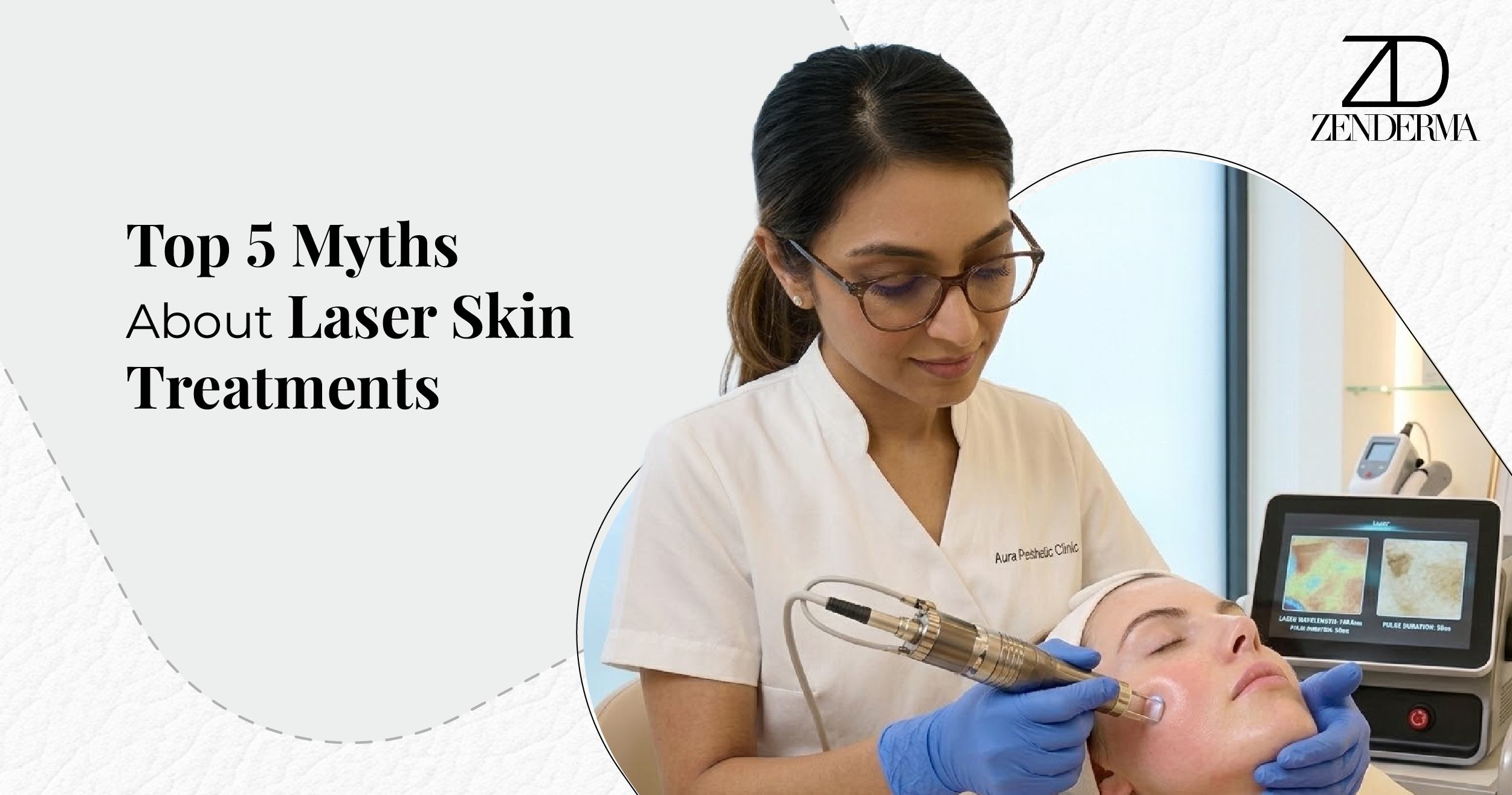
Anyone looking for the best skin care products needs to be able to tell the difference between laser skin treatment myths and facts. Myths about pain and skin thinning, or the idea that lasers aren’t safe for darker skin tones, are what stop people from getting clear skin. Find out how Zenderma’s FDA-approved technology can help you achieve safe, visible, lasting results.
Introduction: Separating Laser Fact from Fiction
Laser technology has revolutionised modern dermatology, offering non-invasive solutions for everything from stubborn acne scars to unwanted hair. However, despite its popularity in the UK and worldwide, a cloud of misinformation persists. Many patients hesitate to book a consultation because of outdated laser skin treatment myths that no longer apply to modern clinical standards.
We at Zenderma believe that the best way to get great skin is to learn. You can make smart choices based on facts, not fear, once you know how concentrated light energy really works on your body—by boosting collagen production instead of “weakening” your skin. It’s time to break down the top five myths that have been keeping you from getting the best skin you’ve ever had, whether you’re looking into a Carbon Laser Peel for a glow or a Q-Switch ND YAG for pigmentation.
Myth #1: Laser Skin Treatments Make Your Skin Thinner
One of the most common laser skin treatment myths is that the “peeling” or “heat” from the laser makes your skin thinner and more fragile over time.
The Medical Truth
What has been said is completely wrong. The CO2 Fractional Laser and MNRF are two examples of modern lasers that are meant to cause a “controlled healing response.” This helps the body make new collagen and elastin in the dermis.
- Collagen Induction: Lasers don’t make the skin smaller; instead, they make it build its framework again.
- More Density: Research has shown that after a series of laser treatments, the dermal layer is thicker, stiffer, and more flexible than it was before.
Zenderma: Laser Technology That Works for Everyone
We stress the importance of safety and effectiveness at Zenderma by using only the best clinical equipment. This is a dermatologist-led practice, which means that a technician does the procedure but also Dr Vignesh Karthick and other experts are in charge.
- The Q-Switch ND YAG Laser is a very specific tool for getting rid of tattoos and skin discolouration. It only changes the colour of the skin and doesn’t hurt the skin around it.
- The CO2 Fractional Laser is the best way to get rid of deep wrinkles and scars.
- The “Hollywood Peel,” also known as the Carbon Laser Peel, removes dead skin cells and tightens your pores without any downtime.
Zenderma uses Advanced Korean Skin Analysis before each treatment to make sure that the laser settings are just right for your skin’s thickness and sensitivity.
Myth 2: Lasers Are Not Safe for Darker Skin Tones
This myth stems from the early days of laser technology when machines struggled to distinguish between the pigment in a hair follicle and the melanin in the skin.
The Modern Advancement
Today, this is no longer a concern in a professional medical setting.
- Wavelength Specificity: Nd:YAG long pulse lasers have a wavelength that goes around surface melanin, making them the safest way to remove hair from darker skin types (Fitzpatrick skin types IV-VI).
- Cooling Systems: Newer models come with built-in cooling tips that keep the skin from getting burnt or too dark.
Myth 3: Laser Treatments Have Harmful Radiation
The word “Radiation” in the LASER (Light Amplification by Stimulated Emission of Radiation) acronym can be misleading.
The Scientific Difference
It is important to know the difference between ionising and non-ionising radiation.
- Medical lasers give off non-ionising radiation, which is just very bright light in the visible and infrared parts of the spectrum. It doesn’t hurt DNA or cause skin cancer.
- Safety Protocols: In fact, lasers are frequently used by dermatologists to treat precancerous lesions and certain types of skin cancer.
Myth 4: You Only Need One Session for Results
We live in an age of instant gratification, but biological change takes time.
The Treatment Cycle
While you may see an immediate “glow” after a Carbon Laser Peel, corrective treatments for scars or pigmentation require a journey.
- The 28-Day Cycle: Your skin takes roughly a month to regenerate.
- Cumulative Benefits: Most of the time, patients need three to six treatments to feel all of the benefits. This lets the laser work on different levels of skin and different stages of hair growth.
Myth 5: Lasers Hurt a Lot
The “burning” that used to happen with older lasers is no longer an issue.
Zenderma’s Patient Comfort
We do everything we can to make sure you’re comfortable while you’re getting treatment.
- Topical Anaesthetics: We use strong topical anaesthetics for deeper resurfacing.
- Feeling: Most patients say they feel a “mild rubber band snap” or a tingling.
- Post-Care: We follow every session with soothing serums and cooling masks to instantly calm any residual warmth.
Comparison: Laser vs. Traditional Skin Care
| Feature | Over-the-Counter Creams | Zenderma Laser Treatments |
| Depth of Penetration | Superficial (Epidermis) | Deep (Dermal Layer) |
| Speed of Results | 6–12 Months | 3–6 Sessions |
| Scar Correction | Minimal | Significant |
| Customisation | One-size-fits-all | Tailored to your skin analysis |
Trusting the Science of Light
Don’t let laser skin treatment myths prevent us from having the clear, youthful skin we deserve. Lasers, when used in a clean dermatologist-operated environment like Zenderma’s, are the single most safe and effective device available to modern medicine. By finding the right wavelength and creating a personal treatment plan, scars, discolouration and ageing can be confidently dealt with.
Don’t let what you think you know about skin care dictate your routine. Contact Zenderma today to schedule your complimentary consultation and determine which laser is right for your skin.
FAQs
1. Are the laser skin treatment myths and cancer true?
No, medical lasers give off light energy that doesn’t ionise, so they don’t hurt DNA or cause cancer.
2. Is there a “best” time of year to start laser therapy?
It is usually best to do this in the winter or autumn, when it is easier to stay out of direct sunlight, which is important for protecting the skin while it heals.
3. Will my skin be sore and peeling for weeks?
This depends on the laser. For example, CO2 lasers may need a few days of peeling, but most lasers, like the Q-Switch, don’t need any downtime.
4. Is it okay for me to get laser therapy if my skin is sensitive?
Yes, but it needs to be looked at very carefully. We do a patch test at Zenderma to make sure that the intensity is low enough for your level of sensitivity.
5. How long do the effects of laser therapy last?
The effects are long-lasting, as the changes are permanent, although occasional “maintenance” treatments may be needed once or twice a year to maintain the anti-ageing glow.
6. Can lasers be used on active acne?
Yes, as some lasers can kill acne-causing bacteria and reduce oil glands to prevent future acne while simultaneously healing existing scars.
7. How can I get my skin ready for a laser treatment?
To minimise skin sensitivity, don’t expose yourself to the sun, use tanning products, and strong exfoliants for a minimum of one to two weeks before the treatment.
8. May laser treatments be combined with other aesthetic procedures?
Laser treatments are really just one of the tools which can be combined with other procedures such as microneedling or medical facials as part of a personalised programme.
9. Are there permanent results from a laser treatment?
Removing pigment and scars may be a permanent situation; however, ageing and sun exposure might require maintenance sessions from time to time.
10. Does laser skin treatment have an age limit?
Almost all adults can undergo laser treatment safely if their skin is properly evaluated during a professional consultation.

Dr. Vignesh Karthik, MD (DVL)
Meet Dr. Vignesh Karthik, MD (DVL) – the expert mind behind Zenderma. With 15+ years of dermatology experience, he leads with precision and compassion. From advanced skin therapies to aesthetic care, your skin is in trusted hands. At Zenderma, we blend science with a personalized approach for every skin type. It’s not just treatment – it’s expert-driven transformation.